Wednesday, June 18, 2008

The Right Tool


Once upon a time I met an artist in one of my classes who was painting little landscape-ish paintings. She said she hated what she was doing... using the tiniest brushes to describe every detail from her source image. So, I asked her "who do you like?" She said "Turner." I said "give me your brush." And then I handed her a palette knife and said "from now on, you only use a palette knife."

I had no idea how one simple adjustment could make such a dramatic change in ones art. I am always telling students to "get a bigger brush" but this was different. Gay Summerrick is a Fine Artist who took the challenge and changed the way she paints and even adjusted her approach to painting. Because with palette knife paintings, its not the overall colors that are important -like the color of the sky or the water or the trees. Its what's underneath that counts!

It's the bit of red or that spec of golden color that appears in between and in places that you can't plan for it to be. It is as if light has filtered through and is pulling everything together. Its the vibration of the colors underneath their primary colors that make the painting pop and for you to say "oh yea, this is good... really good."

When you see Gay's paintings up close, you will see what I mean. Gay has won awards from the Malibu Art Association, and excepted into juried shows with The California Art Club. She also shows at Los Angeles County Museum of Art Sales and Rental Gallery.

Needless to say, I am very proud of her.
Below are some of her landscapes: click on images for detail


Wednesday, May 14, 2008

Kline Academy Instructor GARY BLACKWELL wins Special Award

Gary Blackwell, Title: Friends, Size 11 x 14 Surface: Wallis paper

Kline Academy Instructor GARY BLACKWELL
wins Special Award and Cash Prize
from The Pastel Society of the West Coast


Gary Blackwell, a Signature Member of the PSWC and was given a special award for his entry "Friends" pastel on paper during The PASTELS USA 22nd Annual International Open Exhibition at the Haggin Museum in Stockton CA. The show runs from May 18 to June 22 and is sponsored by the Pastel Society of the West Coast.

Winning competitions is not new to Blackwell - a few years ago he earned the title of "Distinguished Pastelist" after winning three awards in succession in this same competition.


Tuesday, April 15, 2008

Cheryl Kline Receives "Certificate of Excellence" Award from The Portrait Society of America

Cheryl Kline Receives "Certificate of Excellence" Award

Last weekend, The Portrait Society of America held their 10th annual Art of the Portrait conference in Philadelphia, PA.

Over 800 artists from around the world attended. The days were filled with lectures and demonstrations from the most renown portrait artists living today.

Highlights included:

Thursday 4x4 demonstration featuring Jamie McMahan, Wende Caporale, Dawn Whitelaw and Timothy Thies.

Friday morning John Howard Sanden demonstrated. Then, Friday afternoon classes featuring Michael Shane Neal, Rose Frantzen, Calvin Goodman, Wende Caporale, Ying-he Liu, Judith Carducci, Dawn Whitelaw, Chris Saper, Ross Merrill, Robert Liberace, Edward Jonas, Anthony Ryder, Timothy J. Clark and Daniel Greene.

On Saturday, Everett Raymond Kinstler gave an incredible lecture. He talked about the fact that most great portrait artists all painted other things besides portraits. And how important it is to explore nature from life. Most of the great portrait artists (Sargent, Zorn, Boldini, and others) used only 5 to 8 colors to create their masterpieces!

"When you paint hair, make believe you have a comb in your hand."

He gave many other gems while creating this study:

"There are no short cuts"

"All art is feeling"

and

"Be careful of cleverness"

Burton Silverman followed with this demonstration of a model which he painted in about 2 hours!

Burt began over an old paint as his underpainting, "it causes you to be zoned in and more focused"


He started drawing (with paint) with a reddish brown and alizarine very dry paint as an outline to set up the composition on the canvas. Like magic, the figure began to appear. He made a point to keep the shadows transparent (thinned with oil) and many times wiped out the area after applying the paint to actually stain the area with a hue. Then he started the half tones in the face and added the warm color on the nose then the highlight. He worked very fast and slowly built up the impasto highlights. The blond hair was achieved with a reddish undertone and then put the highlights on top.

On Saturday afternoon, Aaron Shikler spoke for an hour about his life as an artist. What a character, all of these speakers had stories to tell about presidents and royalty they painted.

David Leffel closed the day speaking about "finishing' a portrait".


"Finishing is the stretch between the gaps...edges..." This was such a fascinating demo.

First of all Lefell had no model, this was all from memory.

He started with the dark area around the eye, He called this his yin and yang of the eye- "have lights mass and darks mass." His palette consisted of Burnt umber, ultra marine blue, pthalo blue, venetian red, cad orange, yellow ochre and white.

By painting the dark area first he established all the shadows, then, just like sculpting he began to add the mid values that create the lid and around the eyes. The skin under the eye is a warmer red. He connected the white of eye to the lower lid then went in later to add color to the white of the eye on the inside. It was almost orange in tone and I was waiting for him to "fix" it but it all came together. He talked about how to make the eyes transparent and how light will hit one side of the iris.

Regarding solving problems: Instead of softening a shadow transition he said instead, "to take their attention away or divert it to a light next to it."

"Highlights starts crisp and has a tail which (tapers off) and relates it to the surface."

"The dark part of the eyebrow starts under the brow ridge and has a grayer, cooler color by the bone because it is turning in."

"You use more color on the tip of the nose and less color to make it recede." Also by graying out the receding areas and areas that turn the face , you can get a better illusion of the modeling. The under planes are usually cooler.

"Part of closing up the gaps is making other areas stronger"

And more gems..... "Every form begins and ends. "When light hits, it starts..." "Hard edges follow soft edges" "A hard edge is closed, a soft edge is open"

"Front planes are warm, side planes are cool"

It was a fantastic demo, later another artist, Letticia and I were in the lobby bar and Burton Silverman and his friends joined our table and I had the excellent opportunity to further discuss his process and his ideas on finishing a painting.

Saturday night was our Gala Celebration and black tie banquet. When they called my name, I was so proud and humbled to be among the 30 recipients of an Award and be among some of the finest artists in the country. They show your winning image on 3 huge screens in the banquet hall. The 1st prize went to a sculptor at our table, Amy Kann.

To see all the prize winners and the top portraits go to http://www.portraitsociety.org/


This is a bad picture, but I was still walking on clouds and couldn't hold still. Thats Daniel Graves on the left and Charles Cecil on the right.

Later that evening we again went to the lobby bar and Daniel Graves, founder/director of the Florence Academy of Art (the best place I ever studied) was there and also Charles Cecil Founder/director of Charles Cecil Studios. Both of them were honored for An Award of Excellence in Education for their incredible contribution to the studies of figurative art in a classical atelier.

Our last day featured two internationally known artists, Daniel Greene and Nelson Shanks.

Nelson Shanks was another incredible speaker and talked about his work with Princess Diana and their friendship and his many other commissions of well known people. I was so exhausted I didn't take notes. Later we (800 of us) were invited to visit Nelson Shanks atelier/ Studio Incamminati. Where he teaches classical art in a 10,000 square foot space. They had a generous buffet prepared, a portrait demo by some of his teachers and the unveiling of Nelson Shank's latest work.

After that I ran to see the Cecilia Beaux, American Figure Painter exhibit at the Pennsylvania Academy of Fine Arts- incredible! I'm sure if she had been a man, her fame would have been as Sargents.

I highly recommend this conference for next year which will be held in Washington DC.


Saturday, March 29, 2008

Anatomy Of A Portrait

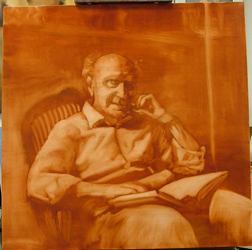
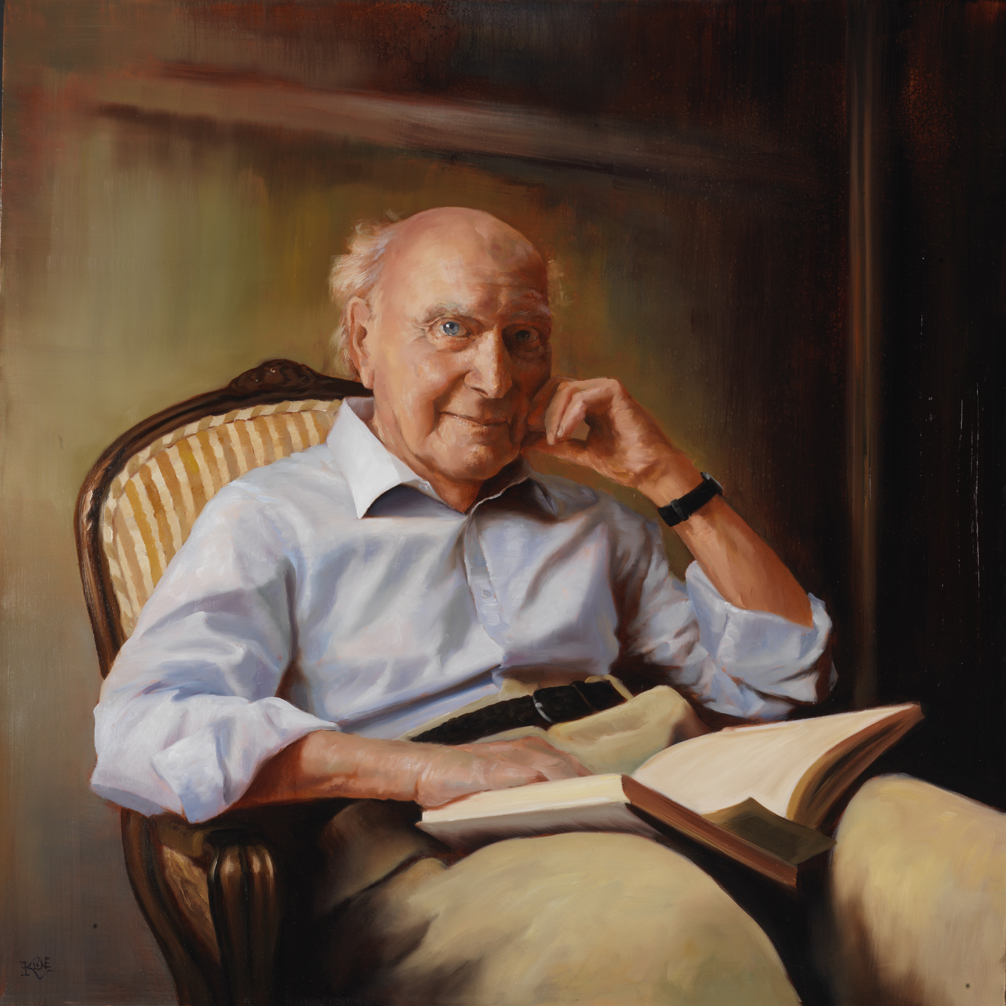
Dr. Wiengarten is the husband of one of my students. Every time I saw him (usually at one of my shows) I knew I had to paint him. He had such a rascal look about him, his thinning white hair, his gentle smile and those eyes! You could see a lifetime in those old soul, blue eyes. One evening I went over to their house and set up a quick photo session. "Where's your favorite chair" "Is that your book?" and with a few adjustments, I knew I had a good shot.

A Note about photo set-up:

When I photographed him, I didn't like the impression of him being looked down upon so I adjusted my view to just below his eye level. Traditionally, commissioned portraits of royalty required the artist's eye level to be lower then their subject, today when an artist sets up a portrait, it depends on what you want to say about your subject and what would be the most flattering position.

Anatomy of a portrait:

Step one: after the drawing, the canvas was covered in red oxide and then the images strongest lights and halftones where "subtracted" or wiped out with a cotton rag.

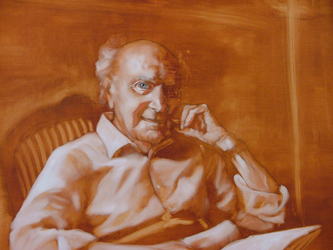
Step two: The gray stage- the painting was reworked with a value study to describe the various values.

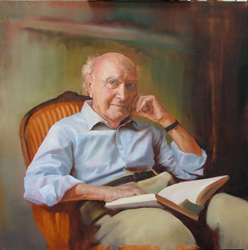
Step three: I got bored with my usual gray study and went right to color. I painted all night I was on such a high, blasting the salsa music to feed my frenzy. I found that I could actually use the "full spectrum painting" idea in this painting quite well. For instance - his shirt would be boring if I stuck to the usual blue tones throughout. In full spectrum painting, as long as you match the same value and temperature,
you can put almost any color your want next to each other and it will make the painting more exciting and alive.

The shirt has pinks, yellows, greens and violet tones, even though the overall coloring is blue those additional colors make it pop.


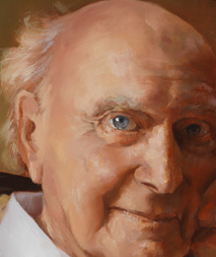
I used the same idea on his head and for the final touches, the eyes, I had Dr. Wiengarten come in for a live sitting. I needed that glint in his eyes and that curl in his lip. You cannot substitute painting from life and even though most of this painting was done from a photograph, it would not have been successful without his live presence.


The final painting.

Most models, you have to urge them into some sort of thought or facial expression to get the blank look off of their face or that frozen fearful thought of "oh my God I'm in the spotlight now what do I do" ...but some models are a natural and Dr. Bill was a natural.


~Cheryl Kline

Kline Academy on Flickr.com

The Kline Academy now has a flickr account where you can view the latest works form the studio. Please join our Flickr contact list and stay up to date!

Welcome to the Kline Academy Blog

The Kline Academy of Fine Art
Is a different place to learn to paint...draw, create, etc.

About 6 years ago, I started a couple of classes teaching painting techniques to a group of people who had all claimed to have years of painting experience but never really learned "how to paint." Since I am a full time artist, this helped to supplement my income. What I taught them, were a combination of old master skills I learned from my Maestro, Jan Saether and from the brilliant instructors at the Florence Academy of Art.

Before I knew it, I had a wait list. Last year, I bought a building to house both my studio and an atelier
for the new "Kline Academy of Fine Art." The best way to describe the importance of classical art training is with an analogy to music: If you want to be a great jazz player - you need to study scales and classical foundations. The same is true in my opinion, to become a great painter. With the impressionists and later contemporary artists, classical painting techniques were practically abolished.

Trends changed and rather then incorporating centuries of painting knowledge, art schools basically “threw the baby out with the bath water.” During the Renaissance, painting techniques were passed down from master to student. Only in the past 5 or 10 years have there been a new group of private ateliers in America as well as some universities that are trying to teach figurative painting techniques that demonstrate the magic that can be produced with a glob of color and a simple brush.

I can't tell you how many students come to me who have had years of art school, have never been "taught" how to paint! But their frustration ends at our front door!

~Cheryl Kline